
NESRA’s first annual, evidence-based assessment of where Nepal actually stands in aerospace and space — and what it can realistically build over the next decade.
Nepal’s place in the space age is usually described in one of two ways: celebrated for launching satellites and training young engineers, or dismissed as a small economy with no business in aerospace. Both miss the truth — and the truth is more useful than either.
Over the coming weeks NESRA will publish the Nepal Aerospace & Space Sector Status Report 2026, an independent reference report covering the country’s aviation system, drones, satellites, Earth observation, satellite communications, navigation, policy, human capital and the realistic opportunities ahead. It is built evidence-first: every consequential claim is sourced and confidence-labelled, announced projects are never presented as operational, and where Nepal’s capabilities are limited, the report says so.
What the report finds
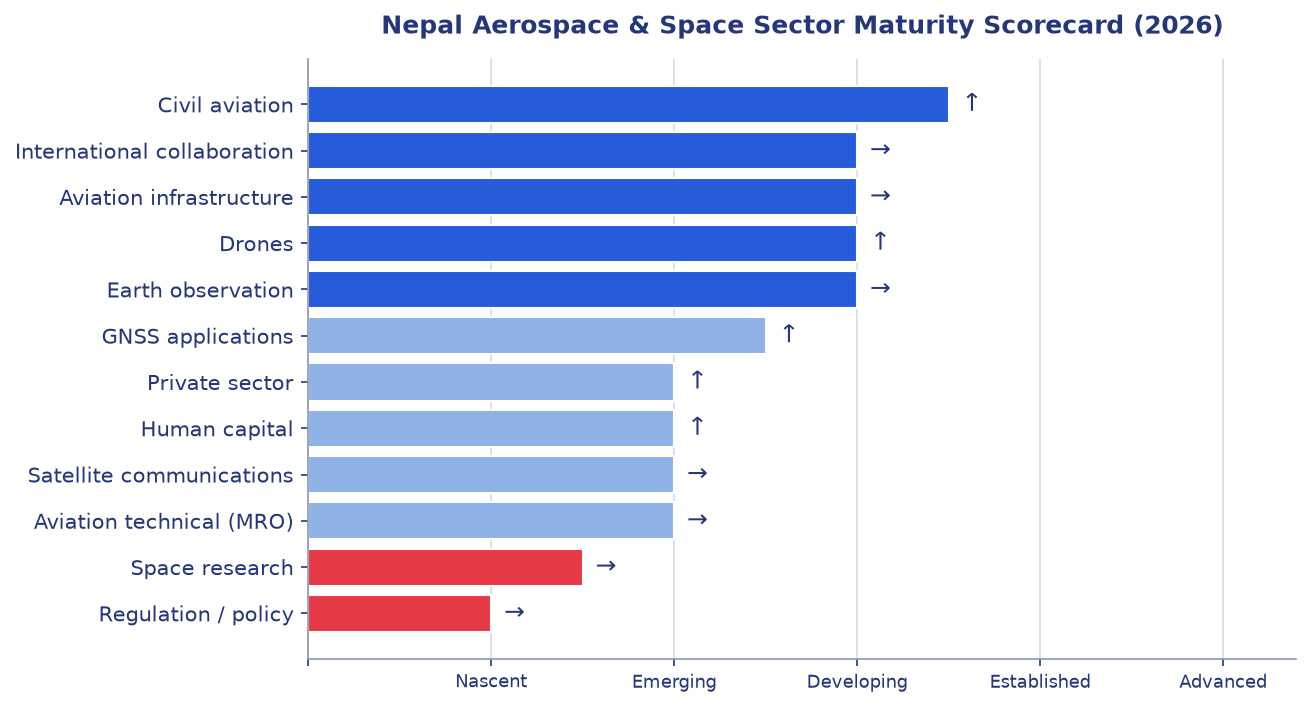
- Aviation is Nepal’s mature aerospace pillar — a record 9.77 million passengers through Kathmandu in 2025 — but safety governance keeps Nepali carriers barred from EU airspace.
- Drones and Earth observation are genuine strengths, delivering real value in disaster response, agriculture, forestry and glacial-hazard monitoring.
- Nepal can grow space-based services without owning a satellite, using freely available data — its most realistic opportunity.
- Governance is the weakest link: no national space policy, no space agency, and Nepal is party to only one of the five UN space treaties.
- The barriers that once reserved space for large states have fallen — what now matters most is governance, regulation and human capital, all within Nepal’s control.
Nepal cannot, and need not, become a space power. It can realistically become an effective, self-reliant user of aerospace and space technology — capturing real economic and public value from a position it already partly occupies.
Inside the report
Eight parts spanning Nepal’s aviation system, uncrewed aviation, the space ecosystem, governance, capability, regional and global context, a scored opportunity matrix, and a strategy to 2035 — with a sector maturity scorecard, a South Asia benchmark, and three scenarios for where Nepal could be in a decade.
Be the first to read it
The full report — with an executive summary, methodology and open data — will be published under Research & Publications shortly. Follow NESRA for the release, and register your interest to receive it directly.
The Nepal Aerospace & Space Sector Status Report 2026 is an independent analysis by the Nepalese Space Research Association, based on publicly available information. NESRA is an independent ecosystem institution; it is not the Government of Nepal, not a national space agency, and holds no regulatory authority.